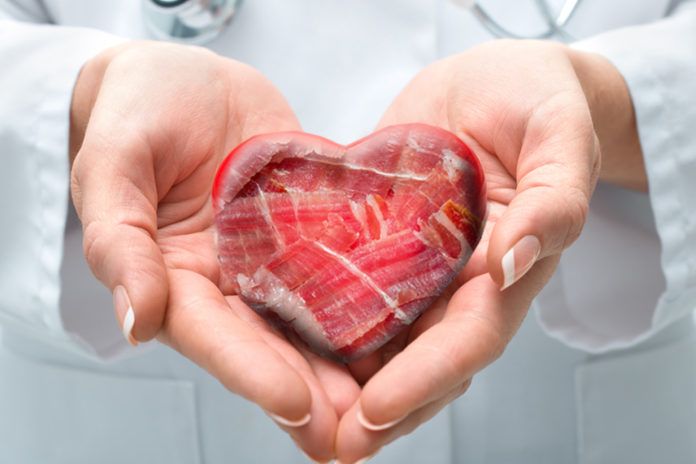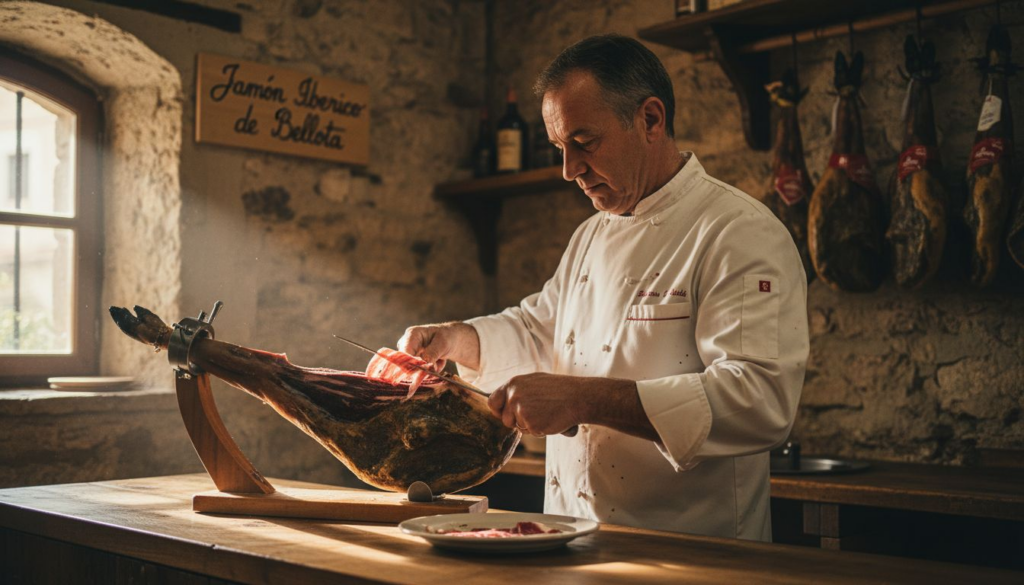
Bold flavours and true craftsmanship make Jamón Ibérico stand out wherever gourmet food is appreciated. For North American culinary enthusiasts searching for an authentic Spanish delicacy, the difference is unmistakable. Crafted from Black Iberian pigs that roam oak-filled dehesas and feed on acorns, Jamón Ibérico delivers rich marbling, a tender texture, and nutty complexity impossible to imitate anywhere else. Discover what sets this prized Spanish ham apart and how you can savour its tradition at home or your next special event.
Table of Contents
- What Sets Jamón Ibérico Apart
- Key Varieties and Labelling Explained
- Traditional Production Methods and Curing
- Health, Authenticity, and Legal Protections
- Choosing and Enjoying Premium Jamón Ibérico
Key Takeaways
| Point | Details |
|---|---|
| Quality of Jamón Ibérico | It is distinguished by the Black Iberian pig, which has unique genetic traits that enhance flavour through intramuscular fat marbling. |
| Acorn-Fed Diet | The diet of acorns and natural foraging underlines the ham’s flavour intricacies, influenced by the region’s terroir. |
| Curing Process | A lengthy and traditional curing process, usually lasting between 12 to 48 months, allows for complex flavour development and is essential for premium quality. |
| Authentication | Protected Designation of Origin (PDO) status ensures that any Jamón Ibérico you purchase meets strict authenticity standards, safeguarding against fraud. |
What Sets Jamón Ibérico Apart
Jamón Ibérico occupies a rarefied category in the world of cured meats, one that North American food lovers are increasingly discovering. Unlike its more accessible Spanish cousins, this ham possesses qualities that demand attention from anyone serious about charcuterie. The difference lies not in marketing hyperbole, but in the convergence of three critical factors: the pig itself, its diet, and centuries of refined production technique.
The Iberian Pig: Nature’s Advantage
At the heart of Jamón Ibérico’s superiority stands the Black Iberian pig, a breed whose genetics create something impossible to replicate elsewhere. These animals possess an exceptional ability that sets them apart from any other breed: they store fat within their muscle tissue rather than just beneath the skin. This intramuscular marbling—the delicate white lines running through the meat—creates a texture and flavour profile that cannot be manufactured or substituted.
The breed requirement is strictly enforced. Official Jamón Ibérico must come from pigs that are at least 50% Black Iberian genetics. The purest designation, Pata Negra (literally “black hoof”), comes from 100% pure-bred animals. This genetic specificity means that the flavour characteristics you experience are directly tied to the animal’s biological composition, not accident or approximation.
The Iberian pig’s unique genetic ability to deposit fat within muscle tissue is what creates the unmistakable marbling that defines premium quality.
The Dehesa Diet: Where Terroir Meets Pork
If the pig provides potential, the acorn-fed diet realises it. These free-roaming animals graze in Spanish dehesas, ancient oak-wooded meadows that have existed for centuries. During the montanera season (typically autumn and winter), pigs feast on fallen acorns, wild herbs, mushrooms, and native fruits. This is not supplementary nutrition—it is the foundation of flavour.
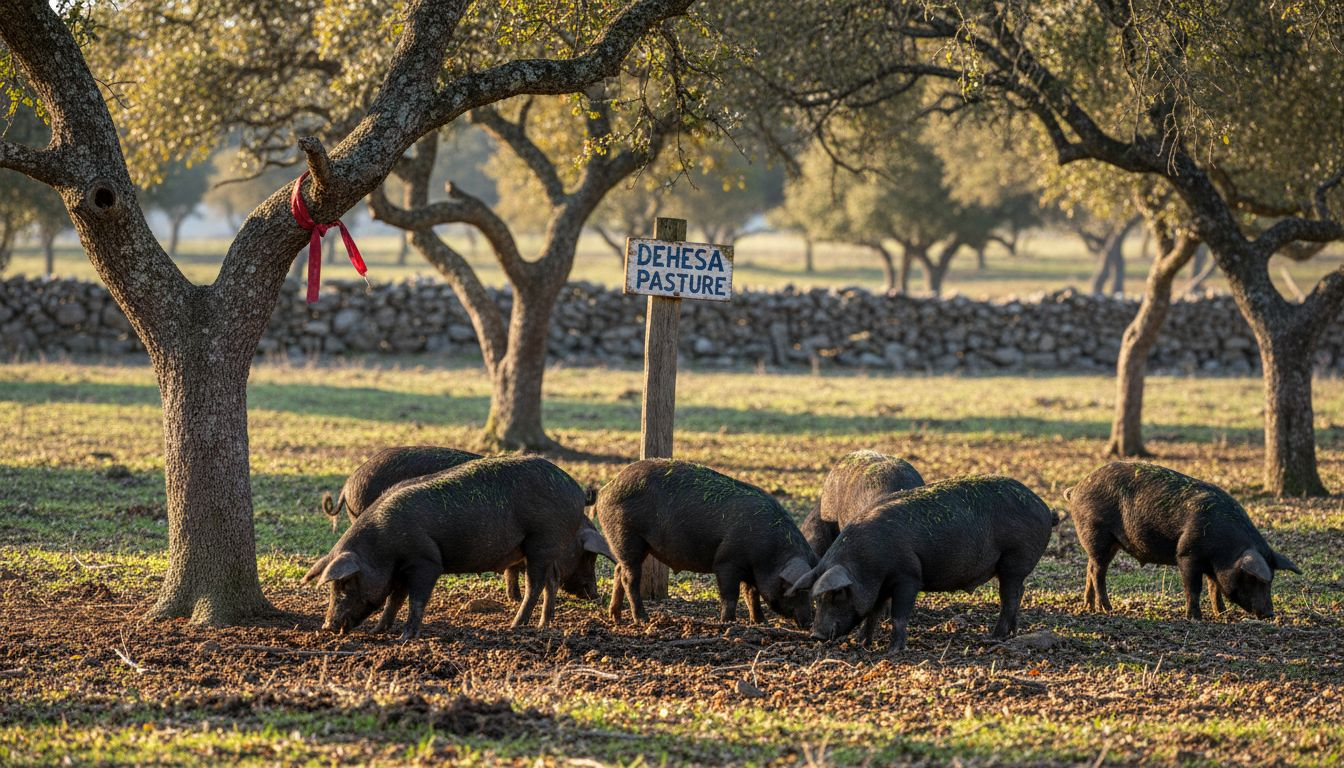
Acorns impart a distinctly nutty, almost sweet undertone that becomes the signature of Jamón Ibérico. The varietal oak trees, the specific plants available in each region, and the length of the grazing season all influence the final flavour profile. When you taste a slice from 7 Bellotas, you are literally consuming the landscape of Andalucía or Extremadura captured in cured meat form.
This is why Jamón Ibérico differs fundamentally from Serrano ham—the latter, made from white pigs, lacks both the genetic marbling advantage and the acorn-feeding tradition. The distinction matters profoundly in the glass or on the plate.
The Curing Process: Time as Essential Ingredient
Production timescales reflect an entirely different philosophy from industrial curing. Jamón Ibérico requires a minimum of 12 months of curing, but the superior grades—particularly those aged 36 months or beyond—demand patience measured in years, not months. This extended timeframe is not arbitrary. During curing, moisture evaporates slowly, enzymes break down proteins into amino acids, and complex flavours develop in layers.
The process involves several distinct stages:
- Dry curing in salt: The freshly butchered ham is covered in sea salt to extract moisture and preserve the meat
- Resting period: The ham sits to allow salt penetration and enzymatic activity
- Washing and air-drying: Salt is rinsed away, and the ham begins its long hang in natural driers
- Extended aging: The ham hangs in temperature-controlled environments, developing the characteristic deep mahogany colour and concentrated flavour
For North American buyers accustomed to ham that arrives at the table within months of production, this timeline represents a genuinely different approach to food. It reflects the Spanish philosophy that quality cannot be rushed, and that some of the finest tastes require the passage of time.
Why This Matters to You
When you purchase Jamón Ibérico, you are acquiring something that cannot be produced in North America regardless of investment or intention. The Black Iberian breed is restricted. The dehesa ecosystem of Spain is unique. The curing traditions, developed over centuries, belong to specific Spanish producers. You are holding the product of a convergence of factors that exist only in particular places and cannot be relocated or replicated.
Comparison to other cured meats becomes almost irrelevant. Prosciutto from Parma, Serrano from Spain, or American country ham all have merit within their categories, yet none possess the complete package that Jamón Ibérico offers. The marbling depth, the nuanced flavour, the silky mouthfeel, and the emotional resonance of its provenance form a combination that keeps sophisticated eaters returning.
Pro tip: When tasting your Jamón Ibérico for the first time, let slices come to room temperature before serving—this allows the intramuscular fat to soften, releasing the full nutty aromatics and revealing why this ham commands its premium position in the global gourmet market.
Key Varieties and Labelling Explained
Walking into the world of Jamón Ibérico for the first time can feel overwhelming. The labels differ. The prices vary considerably. The terminology shifts between Spanish and English. Yet understanding the classification system removes the confusion entirely, transforming those coloured labels from mystery into a straightforward guide to exactly what you are purchasing.
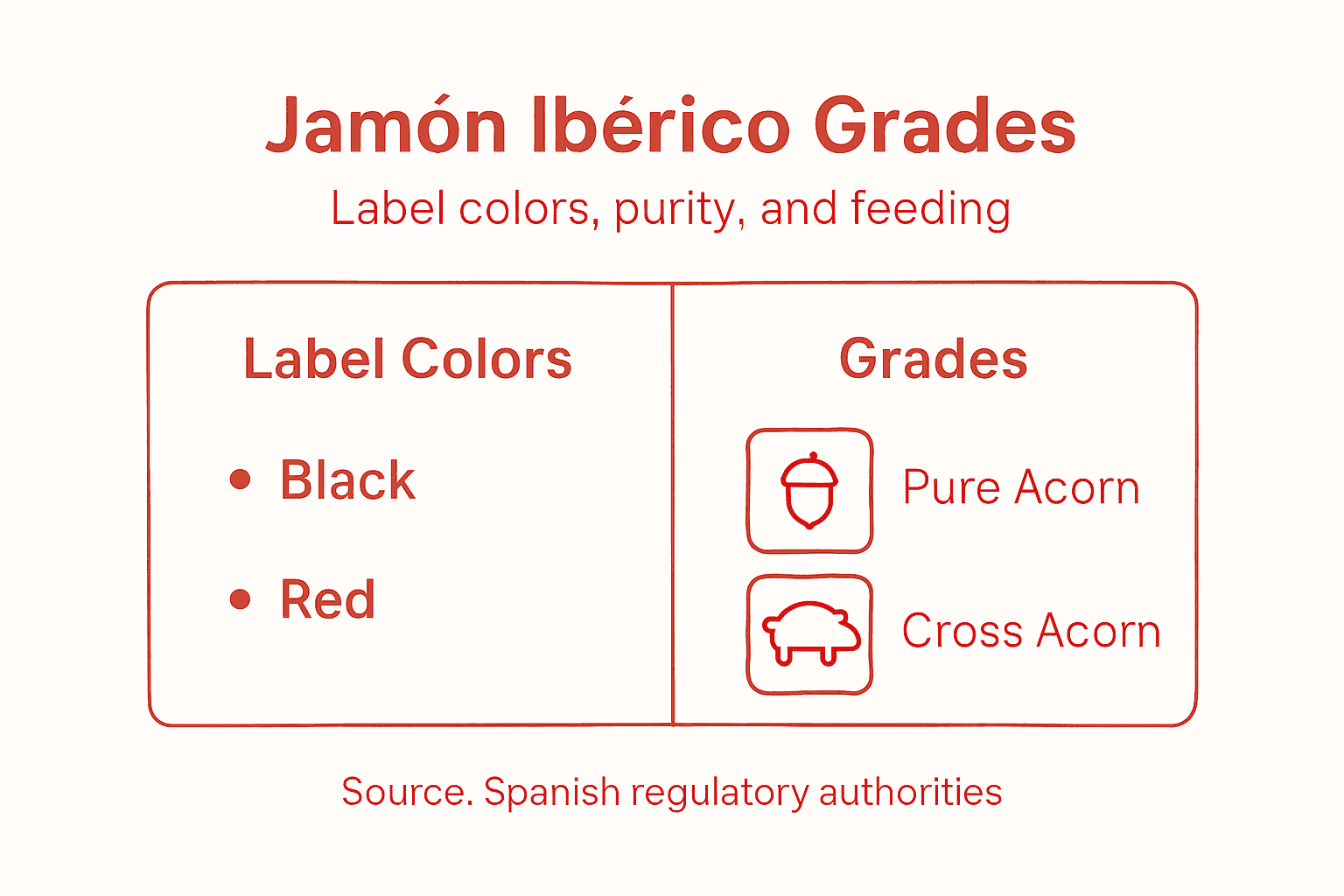
Spain’s regulatory authorities created a colour-coded labelling system that tells you three essential facts about any ham you encounter: the genetic purity of the pig, what it ate, and how it lived. This system exists precisely because North American buyers deserve absolute clarity about what they are investing in. No guessing required.
Understanding the Four Grades
The jamón Ibérico classification system uses colour codes to denote purity and production method. Each colour represents a distinct category, and understanding the differences fundamentally changes your purchasing decisions.
Black Label (Pata Negra) – 100% Pure-Bred Acorn-Fed
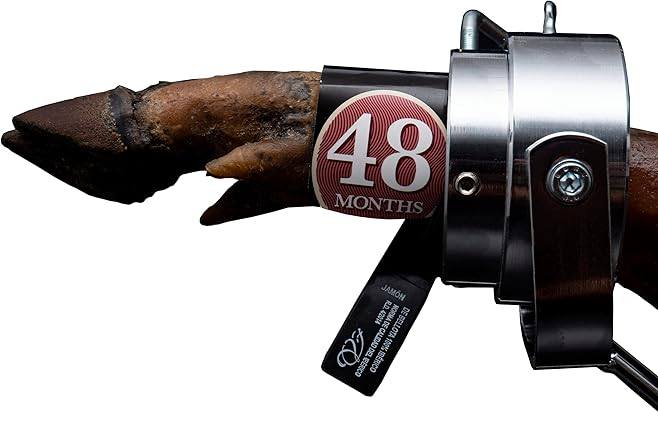
This is the pinnacle. Black labels indicate 100% pure Black Iberian genetics combined with exclusive acorn feeding in the dehesa. These pigs enjoy complete freedom to roam oak-wooded meadows, consuming naturally fallen acorns, wild herbs, and native vegetation. The result is Jamón Ibérico in its most refined expression. Minimum curing time is 48 months, though many producers age them significantly longer. Expect the deepest colour, most complex flavour, and the highest price point. When you purchase a Black label ham, you are acquiring the most prestigious offering the category provides.
Red Label – Crossbred Acorn-Fed
Red labels indicate pigs with at least 50% Black Iberian genetics (the remainder typically Duroc or similar breeds), raised on acorns in the dehesa. These animals still enjoy free-roaming conditions and natural feeding, though the mixed genetics produces a slightly milder flavour profile than pure-bred Black Iberian. Minimum curing extends to 36 months. Red label represents excellent value—you receive acorn-fed quality and extended aging at a more accessible price than Black label options. Many North American enthusiasts find Red label provides the optimal balance between quality and investment.
Green Label – Crossbred Pasture and Grain-Fed
Green labels denote at least 50% Black Iberian pigs raised in pasture conditions but fed on grain supplements rather than exclusively on acorns. These animals enjoy outdoor life but do not consume the full montanera diet. The flavour is notably cleaner and less intensely nutty than acorn-fed varieties. Curing time reaches a minimum of 12 months. Green label offers genuine Jamón Ibérico quality at significantly reduced cost, suitable for everyday appreciation rather than special occasion indulgence.
White Label – Intensive Farm-Raised
White labels represent pigs raised in intensive farming conditions with grain-based diets and no access to natural foraging. These may contain significant non-Iberian genetics or lower percentages of Black Iberian blood. Whilst technically classified as Jamón Ibérico, white label products occupy the entry level of the category. Curing time reaches only 12 months minimum. These are rarely encountered in specialist retailers like 7 Bellotas, which focus on superior grades.
To help you distinguish among Jamón Ibérico categories, here is a concise comparison of label grades:
| Label Colour | Breed Purity | Feeding Regime | Minimum Curing Time |
|---|---|---|---|
| Black | 100% Iberian | Acorn only, free-range | 48 months |
| Red | ≥50% Iberian | Acorn, free-range | 36 months |
| Green | ≥50% Iberian | Grain with pasture | 12 months |
| White | Varied Iberian/non-Iberian | Grain only, farm-raised | 12 months |
Why This Classification Matters
The labelling system protects both producer and consumer. For producers, it ensures their investment in acorn-fed herds and extended aging receives proper recognition and justifies premium pricing. For you, it eliminates any possibility of confusion or misrepresentation. A red label ham is precisely what its label indicates—no more, no less.
The colour-coded system transforms purchasing from guesswork into informed decision-making, ensuring you know exactly what you are investing in.
What to Look for When Ordering
When browsing Jamón Ibérico offerings, the label colour should be immediately visible in product descriptions. Most specialist retailers, including 7 Bellotas, clearly identify the grade and provide curing duration. Several factors work together to determine your final choice:
- Black vs Red: Black delivers maximum complexity and intensity; Red provides acorn-fed quality at better value
- Curing duration: 36 months offers excellent balance; 48+ months provides maximum depth and rarity
- Intended use: Whole hams suit entertaining and long-term enjoyment; sliced portions work for immediate consumption
- Budget parameters: Black label is investment-grade; Red label delivers premium quality accessibly
North American buyers often discover that Red label acorn-fed ham, aged 36 to 48 months, represents their preference point—offering genuine Pata Negra character without the premium pricing of pure-bred Black Iberian. Your palate may differ, and that is precisely why the colour system exists: to enable you to select confidently based on your priorities and circumstances.
Pro tip: When comparing prices between retailers, always verify the label colour, curing duration, and whether you are purchasing a whole ham or sliced portions—these three factors explain nearly all price variation in the market, and understanding them prevents paying premium prices for entry-level products.
Traditional Production Methods and Curing
The transformation of a fresh Iberian ham leg into the delicacy you taste requires no industrial shortcuts, no accelerated processes, and no chemical additives. The traditional production of Jamón Ibérico follows artisanal methods perfected across centuries, with each stage deliberately designed to develop flavour, texture, and the characteristic deep mahogany colour. This is not romantic nostalgia—it is the methodology that produces results impossible to achieve any other way.
When you purchase Jamón Ibérico from 7 Bellotas, you are acquiring the culmination of a process that spans months or even years. Understanding what happens during those months fundamentally changes how you appreciate what arrives at your table. The ham is not waiting passively. Complex chemical transformations are occurring—enzymes breaking down proteins, fats oxidising, moisture evaporating gradually—all contributing to the final sensory experience.
The Salting Stage: Drawing Moisture and Preserving
Production begins immediately after slaughter. Fresh ham legs are covered generously in sea salt, initiating the most critical preservation phase. This stage lasts approximately one week, though duration varies slightly depending on leg size and ambient temperature. The salt draws moisture from the meat through osmosis whilst simultaneously creating an environment hostile to unwanted bacteria.
This is not merely preservation—it is the foundation of flavour development. As salt penetrates the muscle tissue, it triggers enzymatic activity that will continue throughout the curing process. The salt concentration must be precisely calibrated. Too little and preservation fails. Too much and the final ham becomes oversalted and unpalatable. Spanish producers have refined this calculation across generations.
After the initial salting period, the legs are rinsed thoroughly to remove excess salt, then moved to a resting phase lasting several months. During this time, the remaining salt distributes evenly throughout the meat, and the newly drawn moisture evaporates slowly. The ham transitions from freshly butchered to properly cured foundation.
Drying in Natural Conditions: The Critical Transformation
Following the resting period, hams enter the air-drying phase in specialised curing sheds. These facilities are not climate-controlled factories—they utilise natural airflow and seasonal temperature variations to achieve the precise drying conditions that develop Jamón Ibérico’s distinctive character. The sheds are designed to capture breezes whilst protecting hams from direct sunlight and excessive heat.
The drying process unfolds gradually across months. During autumn and winter, cool temperatures slow moisture evaporation, allowing the meat to cure gently. Spring and summer warmth accelerates the process slightly. This natural rhythm creates the conditions for enzymatic breakdown that produces the complex, layered flavours North American enthusiasts find irresistible.
What occurs during this stage cannot be replicated artificially:
- Protein breakdown: Enzymes convert large protein molecules into smaller amino acids, creating savouriness and depth
- Fat oxidisation: The intramuscular fat gradually oxidises, developing nutty and complex aromatics
- Moisture loss: Water content decreases to approximately 50% of the original fresh weight
- Colour development: The meat transitions from pale pink to deep mahogany as oxidation occurs
The natural drying sheds of Spain’s ham-producing regions benefit from centuries of architectural refinement. Ventilation patterns, shed orientation, and material selection all contribute to the precise microclimatic conditions required. These sheds represent irreplaceable infrastructure—they cannot be relocated, replicated, or industrialised.
The Extended Aging: Months or Years of Development
Once sufficiently dried, hams move into cellars for the final aging phase. This is where time becomes the essential ingredient. Minimum curing extends to 12 months for entry-level classifications, but superior grades require 36 to 48 months or longer. During this extended period, the ham hangs in temperature-controlled environments, continuing to lose moisture and develop complexity.
The curing cellars represent where time and tradition converge—each month of aging adds irreplaceable layers of flavour that cannot be created through any other method.
The cellars maintain relatively stable temperatures, typically between 15 and 25 degrees Celsius, allowing slow, steady maturation. The hams lose approximately one-third of their total weight during the full curing process—this weight loss represents moisture evaporation and is a direct measure of curing intensity. A 7-kilogramme fresh leg may yield a finished ham weighing only 4 to 5 kilogrammes after 48 months of curing.
Quality control remains rigorous throughout aging. Master curers periodically inspect hams, checking for any signs of spoilage or defects. The traditional method involves inserting a long needle called a “cata” into specific points, withdrawing a tiny core of ham, and assessing the aroma and texture. This practice, refined across generations, provides immediate feedback about curing progress.
Why Industrial Shortcuts Fail
Modern food production constantly seeks efficiency improvements. Industrial producers might ask: could we accelerate drying with forced air circulation? Could we increase temperature to speed curing? Could we shorten the aging period? The answer to each is technically yes—and the result is demonstrably inferior ham.
Accelerated drying creates uneven moisture loss, resulting in dry exteriors and underdeveloped interiors. Excessive heat damages delicate fats and creates harsh flavours. Shortened aging fails to develop the complex layering that distinguishes truly superior Jamón Ibérico. The traditional methodology exists because it produces results industrial shortcuts simply cannot match.
Pro tip: When selecting a Jamón Ibérico to purchase, prioritise curing duration over other factors—a 48-month ham aged in traditional cellars will deliver substantially more complexity and refinement than a 36-month alternative, and the investment difference is typically 20 to 30 percent rather than substantially more.
Health, Authenticity, and Legal Protections
When you purchase Jamón Ibérico, you are investing in more than flavour and tradition. You are trusting that the product you receive is genuinely what the label claims—acorn-fed, properly aged, and produced according to centuries-old Spanish standards. This trust matters deeply, and it deserves protection. The reality is that counterfeit and mislabelled products circulate in international markets, creating risks for consumers and undermining the livelihoods of legitimate Spanish producers.
Understanding authenticity protections and how they work ensures you confidently select Jamón Ibérico without fear of purchasing inferior or fraudulent products. The regulatory frameworks, scientific verification methods, and seller accountability systems exist specifically to protect North American buyers like you.
The Fraud Problem: Why Authentication Matters
Jamón Ibérico’s premium price creates financial incentive for fraud. Scientific research identifies vulnerabilities in Jamón Ibérico authentication and emphasises the need for rigorous verification of geographic origin and pig rearing systems. Fraudulent producers might substitute lower-cost ham from other regions, misrepresent curing duration, or falsely claim acorn-feeding when animals were actually grain-fed.
These deceptions are not trivial quality issues—they represent direct financial loss to you. A fraudulent “Black label” ham claiming 48 months curing might actually be a Red label product aged only 36 months, yet priced identically. Without authentication protection, distinguishing genuine from counterfeit becomes impossible through visual or sensory inspection alone.
Spanish authorities and the European Union recognise this risk. Over the past two decades, regulatory frameworks have strengthened substantially, and modern analytical methods now allow verification that was previously impossible.
Protected Designation of Origin: Legal Safeguards
Protected Designation of Origin (PDO) status represents the strongest legal protection available for Jamón Ibérico. This designation, awarded by the European Union, restricts the name “Jamón Ibérico” exclusively to ham produced in designated Spanish regions using prescribed methods. The regulations specify:
- Only Black Iberian pigs or approved crosses (minimum 50% Black Iberian genetics) may be used
- Pigs must be raised in specific geographic areas of Spain
- Acorn-fed designations require documented feeding practices
- Minimum curing periods are legally mandated
- Production facilities must meet strict hygiene and quality standards
- Regular inspections and traceability documentation are mandatory
Violating these regulations results in serious legal consequences, including fines, product seizures, and criminal prosecution in severe cases. This legal framework protects you—if you purchase Jamón Ibérico bearing the PDO mark, Spanish law guarantees that your ham meets specified standards.
Modern Authentication Technologies
Analytical authentication methods have evolved significantly to combat fraud. Scientists now employ untargeted analytical approaches that identify chemical markers unique to genuinely acorn-fed, properly aged ham. These methods detect:
- Isotopic signatures revealing what pigs consumed
- Fatty acid profiles distinguishing acorn-fed from grain-fed pigs
- Volatile organic compounds indicating authentic curing duration
- Micronutrient concentrations reflecting production methods
These technologies allow third-party laboratories to verify authenticity with scientific certainty. Major retailers, including specialist importers, increasingly employ these verification methods, providing an additional layer of consumer protection beyond regulatory oversight.
Modern science now allows authentication of Jamón Ibérico with certainty previously impossible—you can verify the product you purchase matches its label claims.
Health and Nutritional Considerations
Beyond authenticity, Jamón Ibérico offers genuine nutritional merit. The intramuscular fat composition differs significantly from grain-fed pork, with higher concentrations of oleic acid—the heart-healthy monounsaturated fat prominent in olive oil. Acorn-fed Iberian pigs develop fat profiles more similar to Mediterranean diets than conventional pork.
The curing process concentrates micronutrients including:
- Iron: critical for oxygen transport and energy metabolism
- Zinc: essential for immune function
- B vitamins: supporting nervous system health and energy production
- Selenium: providing antioxidant protection
The salt content, whilst notable, reflects traditional curing methodology rather than excess. Typical serving sizes—approximately 50 to 100 grammes—contribute moderate sodium levels comparable to other cured meats. Moderation remains the principle, as with any nutrient-dense, flavourful food.
Selecting Authenticated Products
When purchasing Jamón Ibérico, verification markers should be immediately visible:
- Look for PDO protected designation on labels or product descriptions
- Verify the colour-coded label system (black, red, green) indicating production method
- Confirm minimum curing duration explicitly stated
- Purchase from established retailers with transparent sourcing
- Request traceability documentation showing producer and production region
Retailers like 7 Bellotas prioritise authenticity through direct relationships with Spanish producers, transparent labelling, and commitment to specifications. When you purchase from specialist retailers rather than generic importers, you gain access to products with documented provenance and verified production standards.
Counterfeit products typically appear through unfamiliar online sellers offering suspiciously low prices or vague product descriptions. If the price seems too good to be true, or if the seller cannot clearly identify the producer and curing duration, exercise caution.
Pro tip: Always request the producer’s name and the specific region of origin before purchasing—legitimate retailers can provide this information immediately, whilst fraudulent sellers typically cannot, revealing their lack of direct producer relationships.
Choosing and Enjoying Premium Jamón Ibérico
Purchasing Jamón Ibérico represents a commitment to quality, and that commitment deserves guidance. The decision involves more than simply selecting a product—it requires understanding your priorities, matching them to available options, and knowing how to extract maximum enjoyment from your investment. Whether you are purchasing for a special occasion, building a personal collection, or introducing someone else to Spanish cured ham excellence, a strategic approach ensures satisfaction.
The journey from selection to savouring should feel natural and rewarding. When you understand the key decision points and tasting fundamentals, Jamón Ibérico transitions from intimidating luxury into an accessible, genuinely pleasurable experience.
Understanding Your Priorities
Before browsing products, clarify what matters most to you. Different purchasing scenarios suggest different selections. Selecting Ibérico ham for authentic flavour and quality requires understanding whether you prioritise immediate enjoyment, long-term investment, or specific flavour characteristics.
Consider these questions:
- Timing: Do you want to enjoy the ham within weeks, or are you building a collection to age further?
- Occasion: Is this for everyday appreciation, special entertaining, or a gift for someone else?
- Budget: What investment level feels appropriate for your circumstances?
- Quantity: Are you purchasing a whole ham for extended consumption, or sliced portions for immediate use?
- Flavour intensity: Do you prefer subtle, delicate notes or bold, complex character?
Your answers guide the specific grade and curing duration. Someone planning to enjoy ham over several months might select a 36-month Red label. Someone purchasing as a gift might choose a prestige 48-month Black label, smaller portion, and elegant presentation. Someone seeking everyday luxury might purchase sliced portions of a 48-month ham to sample before committing to a whole leg.
Whole Ham versus Sliced: Making the Right Choice
Jamón Ibérico comes in multiple formats, each with distinct advantages. Whole hams offer superior flavour preservation. Once cut, exposed surfaces gradually oxidise, and flavour complexity diminishes over weeks and months. A whole ham, properly stored and gradually consumed, maintains quality for 6 to 12 months after opening. The ritual of slicing, the control over slice thickness, and the extended enjoyment period create an experience impossible with pre-sliced portions.
Yet whole hams demand space, equipment, and commitment. You need a ham stand or holder. Your kitchen or dining area must accommodate a leg occupying significant space. You must be willing to slice regularly and consume gradually. For North American buyers accustomed to convenient, compact food storage, whole hams represent a lifestyle adjustment.
Sliced and vacuum-packed portions offer convenience without compromise to quality. Professional slicers create tissue-thin slices that maximise surface area, allowing you to experience the full sensory profile immediately. Vacuum packing preserves quality for extended periods. This format suits busy professionals, smaller households, or anyone wanting to sample premium Jamón Ibérico before committing to a whole ham investment.
Most serious enthusiasts eventually own both. They purchase sliced portions for immediate enjoyment and experimentation, then graduate to whole hams for the complete experience.
For those unsure about format choice, see this quick reference for whole hams vs sliced portions:
| Format | Advantages | Considerations |
|---|---|---|
| Whole Ham | Best flavour preservation; extended shelf life | Requires slicing equipment; storage space |
| Sliced Portions | Convenient, ready to serve; easy to sample | Must consume quickly after opening; shorter shelf life |
The choice between whole and sliced reflects your lifestyle and commitment level—both deliver authentic Jamón Ibérico pleasure when quality is paramount.
Storage and Handling Fundamentals
Proper storage preserves quality and extends enjoyment. Whether you purchase a whole ham or sliced portions, understanding storage principles ensures you experience the ham as the producer intended.
For whole hams:
- Store in a cool location between 15 and 20 degrees Celsius, ideally with moderate humidity
- Keep the ham on a proper stand, with the cut surface exposed to air for gradual oxidation
- Cover the cut surface with a cloth or paper towel to protect from dust whilst allowing air circulation
- Slice only what you will consume within a few days
- Avoid refrigeration unless necessary—cold dulls flavour and hardens fat
For sliced portions:
- Store in the refrigerator in original vacuum packaging until opening
- Remove from refrigeration 15 to 20 minutes before serving, allowing slices to reach room temperature
- Once opened, consume within a few days for optimal quality
- Store opened portions in an airtight container in the coldest section of your refrigerator
Temperature management matters profoundly. Cold temperatures harden the intramuscular fat, muting the delicate nutty aromatics that define premium Jamón Ibérico. Room temperature allows fat to soften, releasing flavour compounds and creating the silky mouthfeel that makes this ham distinctive.
The Tasting Experience: How to Truly Appreciate
Tasting Jamón Ibérico differs from consuming ordinary ham. This is a sensory exploration, not casual eating. Ibérico ham tasting tips for gourmet enthusiasts reveal that proper technique transforms the experience entirely.
Begin with your senses:
- Visual: Observe the colour—deep mahogany, marbled with white fat lines
- Aroma: Breathe in the nutty, slightly floral notes before tasting
- Texture: Notice the silky, tender quality as the slice melts on your tongue
- Flavour: Allow the complex, layered taste to develop gradually
- Finish: Observe how flavours evolve and linger after swallowing
Avoid distractions during your first tasting. Silence or gentle background music. No competing flavours. A small glass of dry white wine or Spanish sherry complements Jamón Ibérico beautifully, but for initial appreciation, water alone is best.
Eat slowly. One or two slices, savoured over several minutes, provides more pleasure than larger quantities consumed quickly. The melting fat, the savoury depth, the subtle sweetness—these qualities reveal themselves only through deliberate attention.
Building Your Collection
Many North American enthusiasts discover that Jamón Ibérico purchases become recurring. You might start with a single 36-month Red label experience, then progress to a prestige 48-month Black label for comparison. Some collectors maintain multiple hams simultaneously, enjoying different grades for different occasions.
Consider rotating your purchases:
- Seasonal appreciation: Lighter Red label hams in summer, richer Black labels in winter
- Occasion-based selection: Premium grades for entertaining, accessible grades for personal enjoyment
- Comparative tasting: Purchase different producers or curing durations to refine your preferences
- Investment appreciation: Older, longer-aged hams often become increasingly rare and valuable
As your palate develops, you discover preferences. Perhaps you gravitate toward the subtle complexity of 36-month aging. Perhaps you love the intense depth of 48+ month hams. Maybe you find Red label acorn-fed provides your perfect balance of quality and value. These discoveries transform you from casual consumer into genuine enthusiast.
Pro tip: When purchasing your first whole ham, select a 36-month Red label acorn-fed rather than a prestige Black label—this choice allows you to develop proper handling and slicing technique whilst enjoying authentic Jamón Ibérico quality at lower investment, ensuring your first experience sets positive expectations rather than overwhelming your budget.
Experience the True Essence of Jamón Ibérico with 7 Bellotas
The article highlights how Jamón Ibérico’s uncompromising quality depends on unique factors such as the Black Iberian pig genetics, acorn-rich diet, and patient traditional curing methods. These elements create complexity and flavour that cannot be replicated outside Spain’s dehesas. If you seek authentic Jamón Ibérico with verified purity, extensive aging, and the full sensory experience described, 7 Bellotas is your trusted partner. We specialise in artisanal, acorn-fed Pata Negra hams aged from 36 to over 64 months, delivering genuine Spanish heritage right to your door.
Discover premium Iberico ham at 7 Bellotas where every product is meticulously sourced from small-scale producers committed to tradition and quality. Whether you prefer whole legs or convenient sliced portions, our detailed descriptions help you select the perfect cured meat. Do not settle for imitations or less aged alternatives when you can enjoy true craftsmanship. Act now and bring the unmatched flavour and prestige of real Jamón Ibérico into your home with confidence.
Frequently Asked Questions
What makes Jamón Ibérico unique compared to other cured meats?
Jamón Ibérico stands out due to its breeding from the Black Iberian pig, which has unique fat storage characteristics, alongside its acorn-fed diet and traditional curing methods that develop complex flavours and textures.
How is the quality of Jamón Ibérico determined?
The quality of Jamón Ibérico is assessed through a colour-coded labelling system that indicates the pig’s genetic purity, its diet, and the minimum curing time, allowing consumers to make informed choices based on these factors.
What should I consider when tasting Jamón Ibérico for the first time?
When tasting Jamón Ibérico, allow it to come to room temperature to enhance the flavour. Focus on the visual, aroma, texture, flavour, and finish to fully appreciate its unique qualities.
Why is the curing process important for Jamón Ibérico?
The curing process is crucial as it allows moisture to evaporate slowly while complex flavours develop over time. A minimum curing period of 12 months is required, with superior grades aged for 36 months or longer, resulting in richer flavours and a distinctive taste profile.